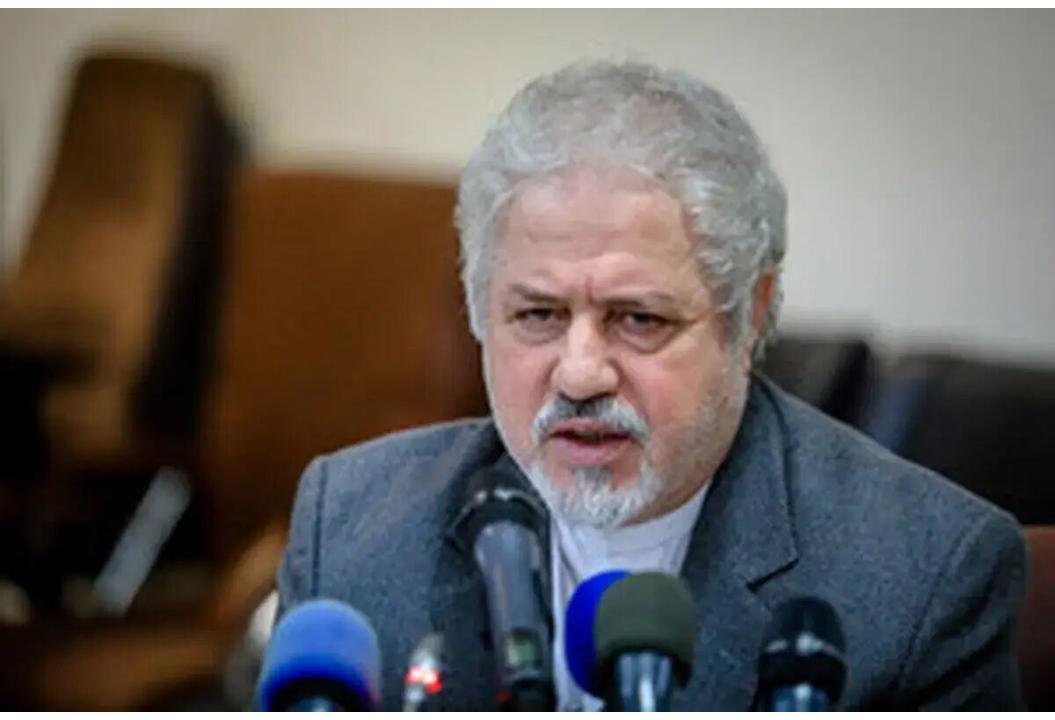
Safeguarding human rights will not be possible without transparency, accountability, the prohibition of discrimination, and an end to double standards, Hakimi said addressing a ceremony unveiling the annual reports on human rights violations in the United States and the United Kingdom.
Referring to developments in the United States in 2026, he said they had revealed numerous serious human rights concerns, including military operations outside US territory and their impact on the right to life, the use of lethal force and violations of the right to life and the treatment of migrants and detainees.
He noted that among the cases under review, US military attacks against Iran on February 28, 2026, were of particular significance, especially given that an independent United Nations mechanism had also addressed the attacks.
The report of the Independent International Fact-Finding Mission on Iran, published on September 17, 2026, was an especially important document.
Hakimi further noted that the fact-finding mission had found reasonable grounds to believe that two US airstrikes against Iran may have constituted war crimes.
The first case involved a missile attack on the Shajareh Tayyebeh elementary school in Minab, Hormuzgan Province, on February 28, 2026.
He further stated that, according to the fact-finding mission’s findings, the attack on the educational facility—which was clearly identifiable as a civilian object, killed more than 150 people, including approximately 120 girls and boys.
The mission considered the attack a possible instance of the war crime of directing an attack against a civilian object.
He also referred to an attack on a sports complex and a residential area in Lamerd County, Fars Province.
According to the same report, the attack was carried out using precision-guided missiles and resulted in numerous tungsten fragments being scattered across the sports complex and surrounding residential area, killing 22 civilians, both men and women.
He stressed that the deaths of schoolchildren in an educational institution and civilians at a sports complex and in a residential area must not be forgotten amid political and military developments.
Hakimi also addressed the human rights situation in the United Kingdom, noting that several developments in 2026 had raised serious concerns regarding fundamental freedoms, non-discrimination, and the country’s compliance with its obligations under international law.
He said one of the most significant issues in this regard was the British government's response to protests related to its ban on the group Palestine Action.
Hakimi also highlighted the British government’s stance on US military operations against Iran as a key human rights concern.
The British prime minister stated in an official statement on March 1, 2026, that the UK had not participated in the initial US and Israeli attacks against Iran and did not intend to join offensive operations.
However, the prime minister confirmed that the British government had agreed to a US request to use British military bases for activities it described as defensive and limited in scope, he stated.
He called for ending the selective use of human rights concepts in international relations.
Human rights must not be used merely as a tool for assessing governments that are political opponents or rivals, he reiterated.
Attacks on schools and sports facilities, the killing of civilians, the deprivation of detainees of their fundamental rights, discriminatory treatment of migrants and minorities, and restrictions on peaceful protests were all issues that must be addressed according to uniform standards of international law, he said.
He underscored that all states must be held accountable for their international obligations, irrespective of their military or economic might or political influence.
Human rights standards must apply equally to all countries, Hakimi said.
The Islamic Republic of Iran, reaffirming its commitment to the principles of the UN Charter and international human rights and humanitarian law, calls on the international community to respond to violations of these principles in a responsible, independent, and law-based manner, he noted.
9376**2050